

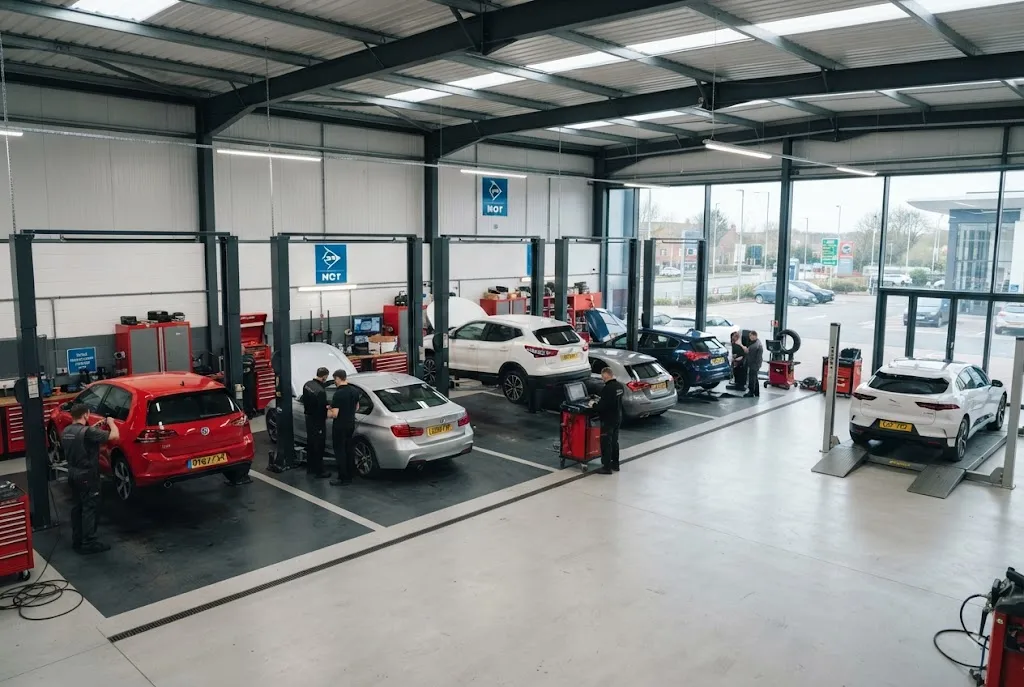
Choosing where to maintain or repair a vehicle can be difficult when motorists have hundreds of local options. Garage chains provide an alternative to independent workshops by offering recognisable brands, multiple locations, online booking and a broad selection of automotive services. Across Britain, these networks range from large fast-fit operators and tyre specialists to body repair groups and regional autocentre businesses.
The UK aftermarket is not dominated by one type of workshop. The sector includes national brands, independent garages, manufacturer-approved repairers, franchised workshops and specialist operators. The Society of Motor Manufacturers and Traders describes the modern aftermarket as a large ecosystem serving more than 42 million vehicles and tens of thousands of workshops across the UK.
For motorists, understanding how different garage chains operate can make it easier to compare convenience, services, coverage and specialist expertise. It also helps explain why some brands concentrate on tyres and fast-fit work while others focus on servicing, accident repair or broader vehicle maintenance.
What Are Garage Chains?
Garage chains are groups of automotive service locations operating under a common brand or network. They may be owned centrally, operated through franchises, or combine company-owned sites with independently managed branches.
The main attraction is consistency. A national or regional network can give customers access to familiar services across multiple locations, often supported by central booking systems, standardised procedures, branded equipment and technician training.
However, not every chain provides exactly the same service. Some specialise in tyres, brakes and exhausts, while others offer MOT testing, servicing, diagnostics, body repairs or fleet maintenance. That distinction matters when choosing a provider.
Why Garage Chains Remain Important in Britain
Garage chains occupy an important position between single-site independent workshops and manufacturer dealer networks. Their scale can provide strong purchasing power, broad geographic coverage and investment in workshop technology.
Convenience is another major factor. A motorist who travels regularly between cities may prefer a network where services can be accessed at multiple branches. Online booking, mobile fitting and centralised customer support can also make routine maintenance easier to arrange.
At the same time, Britain’s automotive aftermarket remains highly competitive. The SMMT notes that the sector includes independent chains, manufacturer-approved repairers, single-site workshops and franchised operations. That means major brands must compete not only with each other but also with thousands of smaller businesses.
Kwik Fit: One of the UK’s Best-Known Fast-Fit Networks
Kwik Fit is one of the most recognisable names among Britain’s garage chains. Founded in 1971, the business has grown into a nationwide fast-fit network with more than 600 centres across the UK and Northern Ireland.
Its core services include tyres, MOT testing, servicing, brakes, batteries, exhausts, suspension and air conditioning. The company also provides mobile tyre fitting, giving motorists another option when visiting a workshop is inconvenient.
Kwik Fit’s scale illustrates one of the biggest advantages of a national garage network: geographical accessibility. Its extensive branch network means motorists can often find a centre without travelling far, while online systems make it possible to compare products and arrange appointments before visiting.
Halfords and National Tyres & Autocare
Halfords has developed a significant presence in vehicle servicing and maintenance through its autocentre network. Its motoring operation covers servicing, MOT testing, repairs, batteries, tyres and other routine vehicle requirements.
National Tyres & Autocare is also part of the Halfords family. The brand describes itself as a fast-fit specialist, with services covering tyres, exhausts, brakes, batteries, MOT testing, safety inspections and car servicing.
The combination demonstrates how consolidation can shape the UK aftermarket. A customer may encounter different brands while ultimately accessing services within the same wider corporate group. For motorists comparing garage chains, checking the ownership and service structure behind a brand can therefore be useful.
Protyre: A Growing Tyre and Service Network
Protyre is another established name within the UK fast-fit and tyre sector. Its network combines tyre-related services with broader vehicle maintenance, making it relevant to motorists looking beyond simple tyre replacement.
Tyre specialists have an important role in the aftermarket because tyres directly affect braking performance, handling and road contact. A modern tyre centre may therefore provide more than fitting and puncture repairs, with services such as wheel alignment, balancing, brakes, servicing and MOT testing also available depending on the location.
For drivers comparing garage chains, the practical question is not simply which brand is largest. It is whether the individual branch provides the exact service required and has the appropriate equipment and technical capability for the vehicle.
Fix Auto: A Different Type of UK Garage Network
Not all garage networks compete for the same type of work. Fix Auto is a useful example because its UK network is primarily focused on accident and collision repair rather than conventional fast-fit servicing.
Fix Auto UK operates through a franchise network of independently owned and managed body shops. The network says it has more than 130 UK locations and that its repair centres are certified to British Standard BS 10125.
This model shows why the phrase “garage chain” can cover different business structures. A body repair network may rely heavily on relationships with insurers, technical training and repair standards, while a fast-fit chain may focus more heavily on tyres, MOTs and routine maintenance.
Fast Fit Autocentres and Regional Networks
The UK market also contains many regional operators. These businesses may not have the national footprint of the largest garage chains, but they can have strong recognition within particular counties or regions.
Regional networks can compete through local reputation, competitive pricing, specialist knowledge and customer relationships. Formula One Autocentres, for example, describes itself as a large independent autocentre chain and has expanded its network substantially in recent years.
There are also smaller regional groups operating under names such as Fast Fit Autocentres. Their importance should not be underestimated. A network does not need hundreds of locations to build strong customer loyalty if it consistently serves a defined geographic market.
What Happened to ATS Euromaster in the UK?
ATS Euromaster is particularly important when examining how quickly the competitive landscape can change. The business historically operated a substantial UK fast-fit network, but its UK light-vehicle operations were wound down in 2026.
The change demonstrates that having a large network does not automatically guarantee long-term viability. Competition, operating costs, customer behaviour and network economics can all influence whether a national automotive service business remains sustainable.
Some ATS Euromaster locations were transferred to other operators. Formula One Autocentres announced the acquisition of 35 former ATS sites on 1 May 2026, taking its network to around 170 locations. This illustrates how one company’s exit can simultaneously create expansion opportunities for another.
How UK Garage Networks Compete
Competition among garage chains is based on more than location. Customers increasingly compare several factors before booking a service or repair.
Service Range
A broad service portfolio can encourage customers to use the same provider for tyres, MOT testing, servicing, brakes, batteries and other maintenance requirements. Specialist networks, meanwhile, can compete by developing deeper expertise in areas such as accident repair or commercial vehicles.
Convenience and Coverage
Large networks have an obvious advantage when customers value accessibility. Multiple branches, online booking and mobile services can reduce the time and effort involved in maintaining a vehicle.
Technology and Equipment
Modern vehicles increasingly require sophisticated diagnostic systems, electronic calibration and specialist workshop equipment. Investment in technology is therefore becoming an important part of the competitive landscape.
Technician Training
Workshop equipment is only useful when technicians know how to use it correctly. Training and technical development are particularly important as vehicle systems become more complex and the market moves towards hybrid and electric powertrains.
Customer Trust
Trust remains central to vehicle maintenance. Drivers want clear explanations, transparent pricing and confidence that recommended repairs are genuinely necessary. National branding can provide familiarity, but the quality of the individual branch experience still matters.
Garage Chains vs Independent Garages
Choosing between a chain and an independent garage is not simply a question of which is better. Each model can have advantages depending on the job, vehicle and customer’s priorities.
Garage chains may offer broader coverage, central booking, standardised processes and access to large-scale purchasing networks. Independent garages can offer local expertise, personal relationships and flexibility, particularly when they have built a strong reputation within their community.
The UK aftermarket is diverse enough for both models to coexist. The SMMT’s description of the sector highlights the importance of independent workshops alongside larger networks and manufacturer-approved repairers.
For motorists, the most useful approach is to compare the actual service being offered rather than relying solely on the size of the brand.
How Garage Chains Are Adapting to Changing Vehicles
The future of garage chains will increasingly be shaped by changes in vehicle technology. Hybrid and electric vehicles require different knowledge, equipment and safety procedures from many conventional petrol and diesel vehicles.
This is one reason technician training and workshop investment are becoming strategic priorities. Customers searching for hybrid servicing may need a workshop with suitable diagnostic capability and technicians familiar with high-voltage vehicle systems.
Electric vehicles will create another major area of change. Businesses offering EV servicing will need to adapt their skills, equipment and processes as the UK vehicle fleet becomes increasingly electrified.
The Importance of Specialist Workshop Services
Large networks are also expanding the range of technical services they can provide. Wheel and steering geometry is one example. Correct wheel alignment can be important when tyres wear unevenly, steering behaviour changes or suspension components have been repaired.
As vehicles become more technologically advanced, customers may increasingly choose workshops based on capability rather than brand recognition alone. Diagnostic systems, calibration equipment, EV safety training and specialist repair skills can all influence where a vehicle is maintained.
What Should Drivers Look for in a Garage Chain?
Before booking a vehicle into a national or regional network, motorists should consider the type of work required and whether the selected branch is equipped for it.
- Check that the branch offers the specific service required.
- Compare the quoted price with other reputable providers.
- Ask what parts and components will be used.
- Check whether the technicians have relevant training for the vehicle.
- Look at recent customer feedback without relying on reviews alone.
- Confirm what warranty or guarantee applies to the work.
- For specialist vehicles, check that the workshop has the appropriate diagnostic and repair equipment.
It is also sensible to distinguish between routine maintenance and complex repairs. A convenient fast-fit centre may be ideal for tyres or an MOT, while a specialist workshop may be more suitable for unusual faults or manufacturer-specific systems.
The Future of UK Garage Networks
Britain’s garage sector is likely to remain highly competitive as operators respond to changing vehicle technology, customer expectations and business costs. Large networks have the advantage of scale, but smaller regional operators can remain competitive through local reputation and specialist expertise.
The rise of hybrids and electric vehicles will make technical capability increasingly important. At the same time, digital booking, mobile services and transparent customer communication will continue to influence how motorists choose workshops.
Consolidation is another factor to watch. The changes involving ATS Euromaster show that established networks can be reshaped quickly through acquisitions, closures and transfers of locations. This can create opportunities for expanding operators while changing the competitive balance between national and regional brands.
Final Thoughts on Garage Chains
The UK’s garage chains represent a broad and evolving part of the automotive aftermarket. Kwik Fit, Halfords, National Tyres & Autocare, Protyre, Fix Auto and regional operators all demonstrate different approaches to vehicle maintenance and repair.
For motorists, the strongest choice is rarely determined by brand size alone. Service capability, technician expertise, workshop equipment, location, pricing and customer service all deserve consideration. As Britain’s vehicle fleet changes, the most successful UK garage networks will be those capable of combining convenience with the technical skills needed to support the next generation of cars.
