
Wheel alignment is an important vehicle maintenance service that helps ensure a car’s wheels and steering geometry are set correctly for the vehicle. When alignment angles move outside the manufacturer’s recommended tolerances, drivers may notice uneven tyre wear, steering that does not feel centred, or a vehicle that pulls to one side.
Modern alignment services use specialist workshop equipment to measure the position and angles of the wheels. Depending on the vehicle, technicians may check and adjust parameters such as toe, camber and caster. Correct alignment can support predictable handling and help tyres wear more evenly.
Wheel alignment is sometimes confused with wheel balancing or described simply as wheel tracking. Although these services can be offered together, they address different issues. Understanding the difference can help motorists choose the right service when a vehicle develops handling or tyre-related symptoms.
What Is Wheel Alignment?
Wheel alignment is the process of measuring and, where adjustment is possible, correcting a vehicle’s wheel and steering geometry so that it meets the relevant manufacturer specifications.
The wheels do not simply need to point straight ahead when viewed from above. Their position is influenced by several geometric angles that affect how the vehicle responds to steering inputs and how the tyres contact the road.
A professional alignment check normally begins with pre-inspection checks. Technicians need to make sure that factors such as tyre condition, suspension components and steering components are suitable for an alignment measurement. If a worn or damaged component is causing the geometry to change, adjusting the alignment alone may not solve the underlying problem.
Why Wheel Alignment Matters
Correct geometry can contribute to stable handling and even tyre wear. When alignment is significantly outside specification, a vehicle may behave differently from how the manufacturer intended.
One common symptom is the vehicle pulling towards one side on a reasonably straight road. Another is a steering wheel that appears off-centre when the car is travelling straight. Uneven wear across a tyre can also indicate an alignment or suspension-related issue, although tyre pressure, load, driving style and component condition can contribute as well.
Alignment therefore forms part of a broader vehicle-maintenance picture rather than being an isolated tyre service.
Wheel Alignment and Wheel Tracking
The terms wheel alignment and wheel tracking are often used interchangeably in the UK automotive service industry. In everyday workshop language, wheel tracking commonly refers to checking and adjusting the alignment of the wheels, particularly the toe settings.
However, the exact scope of a service can vary between garages. Some workshops may advertise a basic tracking adjustment, while others provide a comprehensive four-wheel alignment that measures several geometry parameters.
For this reason, drivers should ask what the quoted service actually includes. A full alignment measurement can provide more information than simply making a single adjustment.
What Are Toe, Camber and Caster?
Wheel alignment involves several geometric measurements. The most familiar are toe, camber and caster.
Toe
Toe describes the direction in which the wheels point when viewed from above. Depending on the vehicle specification, the fronts of the wheels can point slightly towards or away from each other.
Incorrect toe can contribute to uneven tyre wear and affect the vehicle’s directional behaviour. Because toe is often adjustable, it is a common part of alignment work.
Camber
Camber describes the inward or outward tilt of the wheel when viewed from the front or rear of the vehicle. A vehicle can have positive or negative camber according to its design.
Camber affects the way the tyre sits against the road. If it moves significantly outside the intended specification, it can contribute to uneven wear or handling changes.
Caster
Caster relates to the steering axis when viewed from the side of the vehicle. It influences steering characteristics, straight-line stability and the way the steering returns after a turn.
Not every vehicle allows every alignment angle to be adjusted. A technician should therefore use the manufacturer’s specifications to determine which measurements matter and what adjustments are available.
Wheel Alignment vs Wheel Balancing
Wheel alignment and wheel balancing are different services, even though both are commonly associated with tyres and wheels.
Alignment concerns the geometry and positioning of the wheels relative to the vehicle. Balancing concerns the distribution of weight around the wheel and tyre assembly.
An imbalance can produce vibration, particularly at certain speeds. Small balancing weights are normally fitted to compensate for differences in weight distribution.
By contrast, alignment problems are more commonly associated with symptoms such as uneven tyre wear, steering that is not centred or a vehicle that tends to pull in one direction.
A car can therefore require balancing without needing an alignment, or alignment without needing balancing. In some cases, both services may be appropriate.
When Should You Get a Wheel Alignment Check?
There is no single mileage interval that applies to every vehicle. Alignment should generally be considered when symptoms appear or when circumstances suggest that the wheel geometry may have changed.
Drivers may want to arrange an inspection after hitting a significant pothole or kerb, particularly if the vehicle subsequently behaves differently. Alignment can also be worth checking after certain suspension or steering repairs.
Other reasons to investigate include:
- The vehicle pulls noticeably to one side.
- The steering wheel is not centred while driving straight.
- Tyres are wearing unevenly.
- The vehicle’s handling feels different from normal.
- Suspension or steering components have been replaced.
- A wheel or tyre has suffered significant impact damage.
- New tyres show unusual or rapid wear.
These symptoms do not automatically prove that alignment is the cause. A professional inspection is needed to distinguish alignment problems from tyre, steering, suspension or wheel defects.
Why Potholes Can Affect Alignment
British roads can expose vehicles to potholes, raised surfaces, kerbs and other impacts. A sufficiently severe impact can affect wheels, tyres, suspension components or steering geometry.
Sometimes the effect is immediately noticeable. In other cases, a vehicle may continue to drive apparently normally while a small geometry change gradually contributes to uneven tyre wear.
This is why an alignment check can be useful when a vehicle develops a new handling symptom following a significant impact. However, technicians should inspect the complete wheel, tyre, steering and suspension assembly rather than assuming that an alignment adjustment will fix every impact-related problem.
Wheel Alignment and Tyre Wear
Tyres provide one of the clearest reasons to pay attention to wheel geometry. A tyre that is not contacting the road as intended can develop uneven wear patterns.
Drivers should regularly inspect their tyres and monitor tread condition. UK MOT requirements also cover tyre condition, including tread depth, pressure-related defects, seating and other safety-related issues. The current Driver and Vehicle Standards Agency inspection manual provides the applicable inspection guidance for cars and passenger vehicles. :contentReference[oaicite:0]{index=0}
Uneven tyre wear should not automatically be blamed on alignment. Incorrect pressures, worn suspension components, wheel damage, tyre construction and driving conditions can also influence wear.
A proper inspection can help establish whether alignment is contributing to the problem or whether another repair is needed.
How Modern Alignment Technology Works
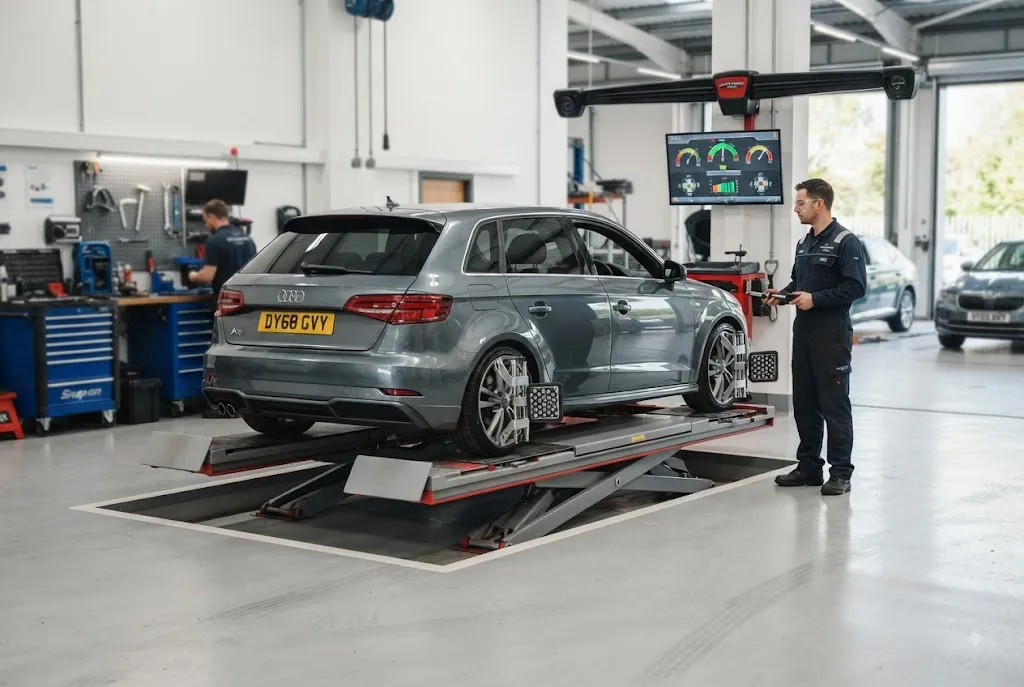
Modern workshops can use computerised alignment systems to measure the position of the wheels against stored vehicle specifications. Depending on the equipment, sensors or targets are attached to the wheels and the system calculates the relevant geometry.
The technician can then compare the measurements with the manufacturer’s recommended tolerances. Where adjustment is possible, the relevant components can be altered and the measurements repeated to confirm the result.
The quality of the result depends on more than the alignment machine itself. The vehicle needs to be prepared correctly, the equipment needs to be in suitable working order and the technician needs to understand the vehicle’s specifications.
The UK’s National Occupational Standards for light vehicle four-wheel alignment state that technicians should use correct technical data, follow vehicle and equipment manufacturers’ recommendations, use suitable equipment and ensure final settings are within the vehicle manufacturer’s recommended tolerances. :contentReference[oaicite:1]{index=1}
Why Workshop Equipment Matters
Alignment technology has developed significantly from basic manual methods. Computerised systems can provide detailed measurements and make it easier for technicians to identify differences between the vehicle’s current geometry and its specified settings.
However, sophisticated equipment does not remove the need for technician expertise. The machine needs to be set up correctly, sensors or targets need to be fitted appropriately and the vehicle must be positioned correctly.
Equipment calibration and maintenance are also important. The relevant National Occupational Standard specifically states that alignment measuring and adjustment equipment should be safe, in good working order and calibrated where necessary. :contentReference[oaicite:2]{index=2}
For motorists, this means the best alignment service is not necessarily the one advertised with the most advanced machine. Technician competence and proper workshop procedures matter just as much.
Steering Alignment and the Steering Wheel
Motorists sometimes use the phrase steering alignment when describing a steering wheel that is off-centre or a vehicle that does not travel straight. In practice, this can be connected to wheel alignment, particularly toe and steering geometry.
However, an off-centre steering wheel can have several possible causes. Incorrect alignment, worn steering components, suspension problems or previous repairs may all need consideration.
The UK MOT inspection manual separately addresses steering condition and steering play. It requires inspectors to assess steering components for wear, fractures and security and provides specific requirements for excessive steering play. :contentReference[oaicite:3]{index=3}
This distinction is important because an alignment service should not be used to conceal a damaged or worn steering component. If a mechanical problem is found, it should be addressed before the vehicle’s geometry is finalised.
Four-Wheel Alignment
Four-wheel alignment measures the geometry of all four wheels rather than focusing solely on the front axle.
This can be particularly relevant on vehicles where the rear suspension geometry influences the vehicle’s overall direction of travel. A technician can assess the relationship between the front and rear wheels and determine whether adjustments are required according to the vehicle’s specifications.
Not every vehicle has the same adjustment possibilities. Some rear alignment angles may be adjustable, while others are fixed by the vehicle’s suspension design. If a measurement is outside specification but cannot be adjusted, the technician may need to investigate whether a worn or damaged component is responsible.
Wheel Alignment After Suspension Repairs
Suspension and steering repairs can change wheel geometry. Replacing components such as suspension arms, steering parts or other geometry-related components may therefore make an alignment check appropriate.
The exact requirement depends on what has been repaired and how the vehicle’s geometry is designed.
Skipping the alignment assessment after relevant work can leave a vehicle with geometry that does not match the manufacturer’s intended settings. This can potentially affect tyre wear and handling.
A workshop should therefore consider alignment as part of the complete repair process when the work has the potential to change wheel positioning.
Wheel Alignment on Electric and Hybrid Vehicles
Alignment remains relevant as the UK fleet becomes increasingly electrified. Hybrid and electric vehicles still depend on tyres, steering and suspension systems for road contact and directional control.
Electric vehicles can have different weight distributions and may deliver strong torque immediately. Correct tyre condition and wheel geometry are therefore still important aspects of maintenance.
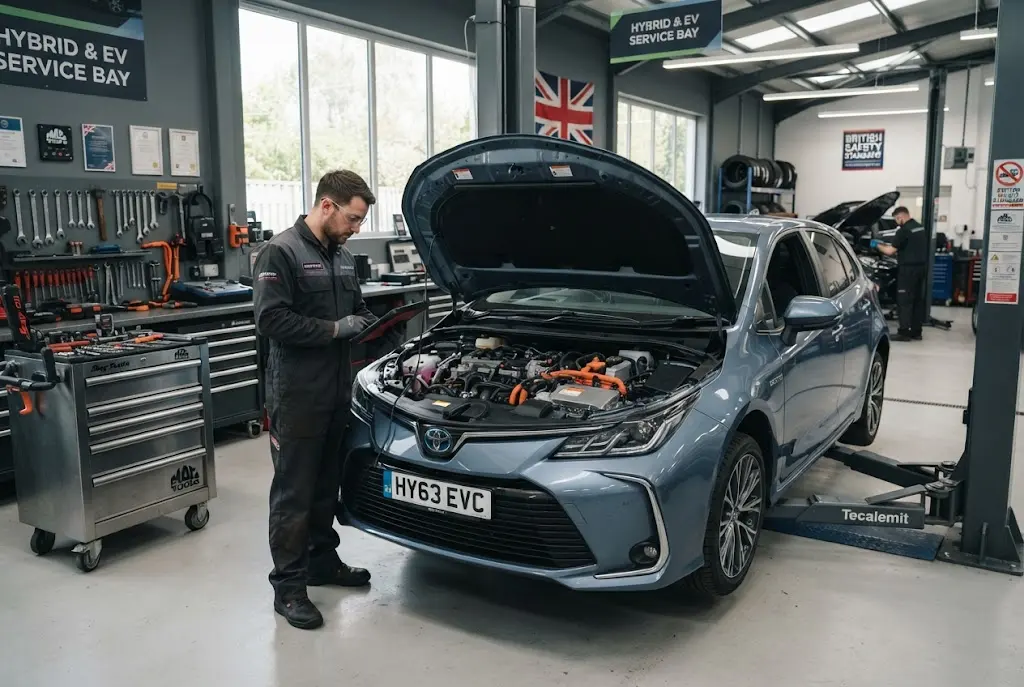
Drivers looking at the wider electrified vehicle maintenance picture can also explore our guides to hybrid servicing and EV servicing.
The increasing complexity of modern vehicles also means alignment work can sometimes interact with electronic systems. Depending on the vehicle, steering angle information or advanced driver-assistance systems may require consideration after certain repairs. The exact procedure is manufacturer-specific.
Is Wheel Alignment Part of an MOT?
A routine wheel alignment service is not the same thing as an MOT inspection. An MOT checks whether a vehicle meets specified roadworthiness requirements at the time of the test. It does not provide a comprehensive alignment measurement for every vehicle.
The current DVSA MOT manual contains detailed inspection requirements for steering, wheels, tyres and suspension. It identifies defects that can affect safe steering, wheel security, tyre condition and other roadworthiness factors. :contentReference[oaicite:4]{index=4}
A vehicle can therefore pass an MOT and still benefit from an alignment check if the driver notices uneven tyre wear or handling changes.
Conversely, an alignment adjustment should not be treated as a substitute for resolving an MOT-relevant steering, wheel, tyre or suspension defect.
Choosing a Wheel Alignment Service
When selecting a workshop, motorists should look beyond the headline price. A professional alignment service should involve appropriate inspection, measurement and adjustment procedures.
Useful questions include:
- Does the workshop provide four-wheel alignment?
- What alignment equipment does it use?
- Is the equipment maintained and calibrated where required?
- Does the technician use manufacturer-specific technical data?
- Will the vehicle be checked for worn steering or suspension components first?
- Will the workshop provide alignment measurements before and after adjustment?
- Are additional repairs explained before they are authorised?
A before-and-after measurement report can be useful because it shows what the equipment detected and whether adjustments changed the relevant values.
How Wheel Alignment Fits Into Modern Garage Services
Wheel alignment is increasingly connected with a wider range of workshop services. Tyre specialists, fast-fit businesses, independent garages and national service networks can all offer alignment checks.
For automotive service companies, investment in alignment equipment can support broader tyre, steering and suspension services. It can also help workshops respond to customers experiencing uneven tyre wear or handling concerns.
Large garage chains may offer alignment across multiple branches, while specialist independent workshops can compete through technician expertise and detailed vehicle-specific work.
The Future of Wheel Alignment Technology
Vehicle technology is continuing to influence alignment equipment and workshop procedures. Modern cars increasingly use electronic steering systems, advanced suspension designs and driver-assistance technologies that can make accurate geometry more important.
Alignment equipment is therefore likely to continue becoming more sophisticated, while technicians will need to understand how mechanical adjustments interact with electronic systems.
Training standards already emphasise the importance of manufacturer data, suitable equipment, correct techniques and final settings within specified tolerances. :contentReference[oaicite:5]{index=5}
For workshops, this creates an opportunity to differentiate through technical competence rather than simply offering a low-cost tracking service.
Final Thoughts on Wheel Alignment
Wheel alignment is an important part of vehicle maintenance because correct wheel geometry can support predictable handling and even tyre wear. It is different from wheel balancing, although both services may be required when a vehicle develops tyre or driving-related symptoms.
Drivers should consider an alignment check when they notice pulling, an off-centre steering wheel, uneven tyre wear or changes following a significant impact or relevant suspension repair.
The quality of the service depends on appropriate workshop equipment, accurate vehicle data, proper preparation and technician expertise. As vehicles become more sophisticated, these requirements will become increasingly important.
For motorists, choosing a workshop that measures the vehicle properly and follows manufacturer specifications is more valuable than simply choosing the cheapest alignment service. Accurate diagnosis and correct adjustment can help ensure that the vehicle’s wheels and steering geometry are working as intended.