
Most drivers compare car insurance quotes the wrong way: they look at the cheapest price, click, and only discover at claim time what they actually bought. Insurers know this, which is why headline prices are engineered to win comparison tables rather than to describe the cover fairly. The good news is that comparing properly takes about twenty extra minutes and one simple rule: never compare prices until you have made the policies identical. Two quotes are only comparable when the cover, the excess and the add-ons match, and this guide shows how to force that comparison step by step.
Whether you are insuring your first car or renewing after years with the same insurer, the method below will save you from the three classic mistakes: buying a lower level of cover by accident, choosing a voluntary excess you cannot afford, and paying twice for add-ons you already have elsewhere.
Step One: Fix the Cover Before You Look at Prices
Decide the level of cover first and hold it constant across every quote. In the UK that means choosing between third party only, third party fire and theft, and comprehensive. Comprehensive is often cheaper than the lower levels for many drivers, because insurers price the risk profile of who buys each type, so always get a comprehensive figure even if you expect to buy less. Then fix the details that quietly differ between policies: protected no-claims bonus, legal expenses cover, courtesy car provision and windscreen cover.
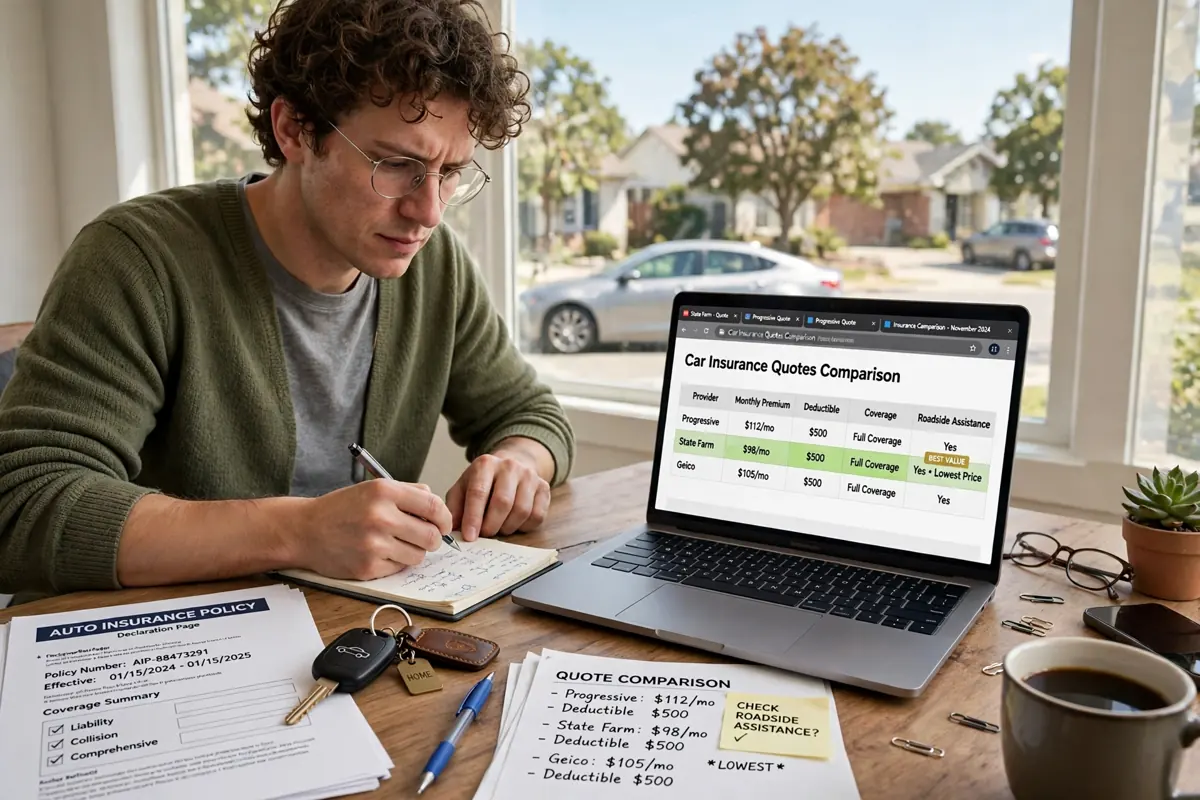
Write your fixed specification down before you open a comparison site. When you compare car insurance quotes against a written spec, a quote that looks £80 cheaper usually reveals itself as the same policy with the legal cover and courtesy car stripped out. If you are reviewing your whole cost of car ownership at the same time, our guide to Car Service Cost in the UK: What Drivers Should Know shows how servicing and insurance together make up the real annual figure, and it is worth having both numbers in front of you before you commit to either.
Step Two: Set an Excess You Can Actually Afford
The excess is the amount you pay towards any claim, and it is split into compulsory and voluntary parts. Raising the voluntary excess is the fastest way to make a quote fall, which is exactly why it is dangerous: a £1,000 total excess is a bargain premium and a serious problem on the day you actually claim. Set the voluntary excess at a figure you could pay tomorrow without borrowing, then hold it the same across every quote.
While you are in the details, check the exclusions that catch drivers out. Some policies exclude driving other cars entirely, some restrict commuting or business use, and some cheaper policies are telematics-based, with a black box or app monitoring your driving. None of these are necessarily bad, but they must be choices, not surprises. The same habit of checking what a service really includes applies across car ownership: our explainer on MOT and Service: UK Rules, Costs and Compliance Guide walks through what an MOT and service do and do not cover, and insurance small print rewards exactly the same careful reading.
Step Three: Strip Out Add-Ons You Already Own
Breakdown cover, legal expenses, key cover and personal accident cover are the profit centre of modern motor insurance, and many drivers already hold them elsewhere. Breakdown cover may come with your bank account or car purchase; legal expenses may be included in home insurance; a new car warranty may duplicate the courtesy car promise. Before you compare car insurance quotes, list what you already have, then untick the duplicates in every quote.
Be careful in the other direction too. If you rely on driving other cars on your policy for emergencies, confirm it survives in the new quote, because it is increasingly restricted to comprehensive policies and older drivers. And if you are changing cars as well as insurers, our guide to The UK Used Car Market: How to Buy and Sell Safely covers how to buy and sell safely, including the insurance gap mistakes people make between selling one car and collecting the next.
Step Four: Give Every Insurer Identical Facts
Quotes are only honest if the facts are. Use the same annual mileage, the same overnight parking description, the same job title wording and the same no-claims history for every quote, because small differences swing prices dramatically. Your job title alone can change a premium, and while you must always answer truthfully, it is legitimate to choose the most accurate of the standard descriptions an insurer offers.
Timing matters as well. Renewal research consistently shows that quotes obtained around three weeks before the start date are cheaper than those bought the day before, because insurers price last-minute buyers as higher risk. Set a diary reminder, gather your fixed specification, and run the comparison once, properly, rather than repeatedly with shifting details that make the results meaningless.
Step Five: Check the Insurer, Not Just the Number
The final step before you pay is to look at who you are buying from. Check the insurer’s claims reputation and customer service scores, confirm the policy is with a UK-authorised insurer, and read how claims are reported: an app and a 24-hour line are worth real money at 11pm on a wet motorway. If your current car has been giving you trouble, it is also worth sense-checking whether the car itself is inflating your risk profile; our guide to Car Battery Keeps Going Flat: Causes, Checks and Fixes explains the common causes and fixes, and a car that breaks down less is a car that claims less.
Then, and only then, choose the cheapest quote that matches your written specification. That discipline — spec first, excess fixed, add-ons stripped, facts identical, insurer checked — is how you compare car insurance quotes like an underwriter rather than a gambler. Twenty minutes of it, once a year, is the best-paid time in motoring.