
EV servicing is becoming an increasingly important part of the UK automotive aftermarket as more drivers switch from petrol and diesel vehicles to battery electric cars. Electric vehicles have fewer conventional mechanical components than combustion-engine cars, but they still require regular inspections, maintenance and specialist technical attention.
Electric vehicles use high-voltage battery systems, electric motors, sophisticated electronic controls, regenerative braking and advanced driver-assistance technology. As a result, maintaining an EV involves a different combination of mechanical, electrical and diagnostic skills.
For drivers, the key question is no longer simply whether a garage services cars. It is whether that workshop has the equipment, training and procedures required to work safely and competently on electric vehicles.
What Is EV Servicing?
EV servicing involves inspecting, maintaining and, where necessary, repairing the systems used by a battery electric vehicle. Unlike a conventional petrol or diesel service, there is no engine oil or traditional exhaust system to maintain. However, an EV still contains many components that require regular inspection.
Depending on the vehicle and manufacturer’s schedule, maintenance can include checks of tyres, brakes, suspension, steering, lights, cooling systems, charging equipment and electrical components. Technicians may also use specialist diagnostic equipment to assess faults and vehicle system information.
The exact service requirements vary between manufacturers and models. Therefore, owners should always use the manufacturer’s maintenance schedule as the starting point rather than assuming that every electric car needs the same checks at the same intervals.
Why EV Servicing Matters
Electric vehicles can have lower routine maintenance requirements than comparable combustion-engine vehicles, but that does not mean they are maintenance-free.
Tyres, suspension, steering and braking components still experience normal wear. An EV’s weight, torque delivery and regenerative braking characteristics can also influence how certain components are used.
Regular inspections provide an opportunity to identify problems before they affect safety, reliability or vehicle performance. They can also help owners maintain a documented service history, which may be useful when selling or transferring the vehicle.
Servicing is particularly important when a vehicle develops warning messages, charging problems, unusual noises, changes in braking behaviour or unexpected reductions in performance. These symptoms should be assessed by an appropriately trained technician.
What Is Checked During EV Servicing?
There is no universal EV service checklist because manufacturers use different vehicle architectures and maintenance schedules. However, several areas are commonly relevant.
Battery System
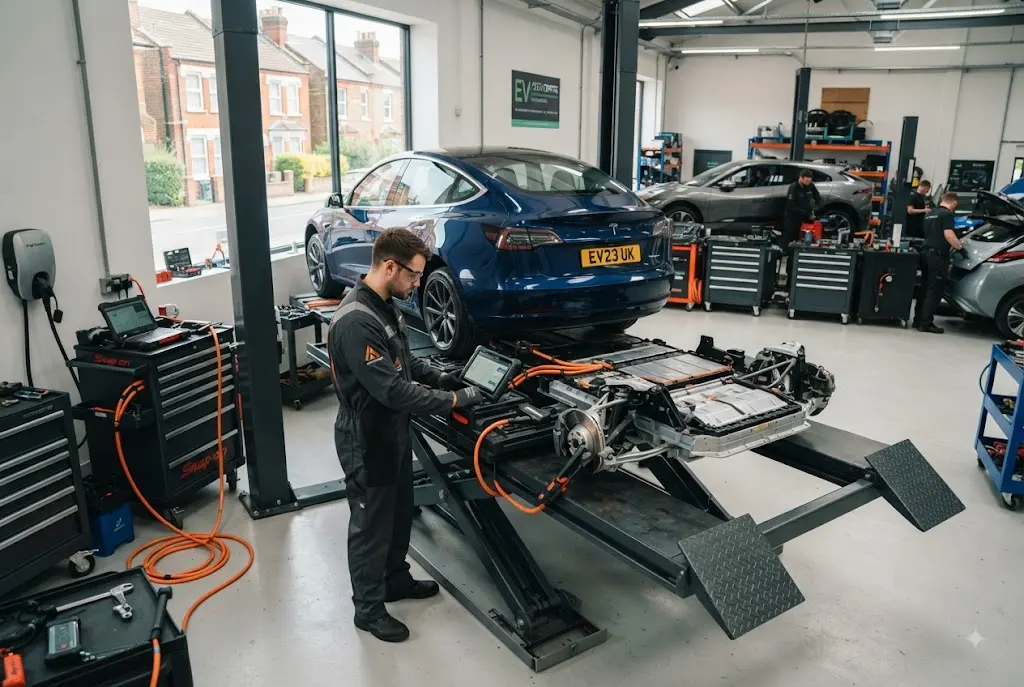
The high-voltage battery is one of the most important components in an electric vehicle. It stores the energy required to power the electric motor and other vehicle systems.
Technicians may use diagnostic information to identify battery-related faults or irregularities. Depending on the vehicle, they may also inspect associated cooling systems, electrical connections and other components connected to the battery system.
Battery work should only be carried out by appropriately trained personnel using the correct procedures and equipment. A battery warning does not necessarily mean that the entire battery pack needs replacing, so proper diagnosis is important before expensive repairs are considered.
Electric Motor and Power Electronics
Electric motors contain fewer moving components than combustion engines, but they remain an important part of the drivetrain. Power electronics manage the flow of electrical energy between the battery and motor and can also interact with other vehicle systems.
These components require specialist knowledge when faults occur. A technician needs to understand the relationship between electrical systems, control modules, sensors and mechanical drivetrain components before identifying the cause of a problem.
Brakes and Regenerative Braking
Regenerative braking allows an EV to recover some kinetic energy during deceleration. This energy can be returned to the battery rather than being lost entirely as heat through conventional friction braking.
Because regenerative braking can reduce reliance on friction brakes in certain driving conditions, brake components may experience different usage patterns compared with conventional vehicles.
Nevertheless, brake discs, pads, callipers and related components still need inspection. Corrosion, wear or other problems should not be overlooked simply because regenerative braking is available.
Tyres
Tyres remain a critical maintenance item for electric vehicles. EVs can deliver strong and immediate torque, while battery packs can make some models relatively heavy. These characteristics make correct tyre selection, inflation and condition particularly important.
Drivers should regularly check tyre pressures and tread condition and arrange professional inspection when they notice uneven wear or changes in handling.
Wheel geometry can also affect tyre wear and vehicle behaviour. Our guide to wheel alignment explains why correct steering and suspension geometry remains relevant to modern vehicles, including EVs.
Do Electric Cars Need Servicing?
Yes. Electric cars generally require less routine mechanical maintenance than combustion vehicles, but they still require servicing and inspections.
The major difference is the type of maintenance involved. An EV does not need regular engine oil changes, spark plug replacement or exhaust-system maintenance. Instead, servicing can focus more heavily on tyres, brakes, suspension, steering, cooling systems, electrical components, software and diagnostic checks.
This can make EV servicing structurally different rather than unnecessary.
Owners should therefore avoid assuming that an electric vehicle can simply be driven without maintenance until something goes wrong. Preventive inspections can help identify wear and faults before they become larger problems.
EV Mechanics Need Different Skills
The transition to electric vehicles is changing the skills required across the automotive workforce. Traditional mechanical knowledge remains valuable, but EV technicians also need to understand high-voltage electrical systems and vehicle-specific diagnostic procedures.
The Institute of the Motor Industry’s EV accreditation framework covers technicians working on inspection, maintenance and repair of electric vehicles, including vehicles fitted with high-voltage batteries and components.
Training requirements can vary depending on the level and type of work being performed. Routine maintenance around an EV is different from opening, testing or repairing high-voltage components.
For this reason, drivers should not assume that every conventional mechanic is automatically qualified to perform every type of EV repair.
Why High-Voltage Safety Is Important
Electric vehicles contain high-voltage systems capable of presenting serious electrical hazards. Workshops therefore need appropriate safety procedures, equipment and technician competence when carrying out relevant work.
Isolation procedures are particularly important before technicians perform work that could expose them to high-voltage components. The correct process depends on the vehicle and the type of work involved.
Workshop owners also need to understand the limits of their technicians’ training. If a repair falls outside the capability of the available staff, it may need to be referred to a suitably qualified specialist.
For motorists, this makes technician competence an important consideration when selecting an EV workshop.
EV Diagnostics and Software
Modern electric vehicles depend heavily on electronic control systems. Diagnostic equipment can therefore play a major role in EV maintenance and repair.
A warning light or dashboard message may be generated by a sensor, control module, communication fault or electrical component. Identifying the actual cause requires more than simply reading an error code.
Technicians need to interpret diagnostic information in the context of the vehicle’s systems and manufacturer procedures. Software updates can also form part of the ownership experience, particularly where manufacturers introduce changes affecting vehicle functions or system performance.
This is one reason modern EV workshops need a combination of technical training, diagnostic equipment and access to appropriate vehicle information.
EV Battery Servicing and Battery Health
Battery health is one of the most important long-term considerations for EV owners. The battery is a major vehicle component, and its condition can influence driving range and overall vehicle usability.
Battery performance naturally depends on factors such as vehicle design, age, usage patterns, temperature and charging behaviour. However, drivers should not assume that a reduction in estimated range automatically means the battery requires replacement.
Professional diagnosis can help determine whether a reported battery concern is related to the battery itself, temperature management, software, charging conditions or another part of the vehicle.
When battery repairs are required, the work can be technically demanding. The appropriate solution might involve diagnosis of individual components, repair of associated systems or, depending on the vehicle and fault, more extensive battery work.
Charging Infrastructure and EV Maintenance
Charging infrastructure is closely connected to EV ownership, although not every charging problem originates within the vehicle.
An EV may be charged at home, at work or through public charging infrastructure. Problems can therefore involve the vehicle, charging cable, wall-mounted equipment, electrical supply or public charging network.
When an EV repeatedly fails to charge, the first step should be identifying where the problem occurs. Trying another compatible charger can help establish whether the issue follows the vehicle or remains at a particular charging point.
Where a vehicle-side fault is suspected, an EV technician can investigate the relevant charging and electrical systems.
How EV Servicing Differs From Hybrid Servicing
Electric vehicles and hybrids share some electrical technologies, but their servicing requirements are not identical.
A hybrid combines an electric powertrain with a combustion engine, so it retains many conventional maintenance requirements. A battery electric vehicle relies entirely on electric propulsion and therefore removes several engine-related service items.
Our guide to hybrid servicing covers the maintenance requirements of vehicles that combine combustion and electric propulsion.
For workshops, the distinction matters because technicians need to understand the architecture of the specific vehicle they are working on rather than treating all electrified vehicles as one category.
The Growth of EVs Is Changing the UK Aftermarket
The UK market is moving towards greater electrification. Recent SMMT registration data shows continued growth in battery electric vehicle registrations, with battery electric cars accounting for 30% of new car registrations in June 2026. Year-to-date battery electric registrations were also higher than the corresponding period in 2025.
This growing vehicle population has direct implications for the service and repair industry. More EVs on British roads mean more demand for technicians who can safely inspect, maintain and repair them.
The change is not limited to independent garages. National workshop networks, authorised service centres, accident repair businesses, tyre specialists and mobile service providers all need to consider how EV technology affects their operations.
As the wider market develops, automotive service companies will increasingly compete on technical capability as well as location, price and customer service.
The EV Workforce Challenge
Workforce development is one of the major challenges facing the UK’s EV service industry. The number of technicians with relevant qualifications is increasing, but industry forecasts indicate that demand could grow faster than supply.
The Institute of the Motor Industry reported in June 2026 that 74,734 technicians held an EV qualification, representing around 35% of the UK technician workforce. Its forecast projected that demand could exceed supply by more than 43,000 technicians by 2035 if qualification growth does not keep pace.
Recruitment trends also show increasing interest in EV-specific skills. The IMI’s June 2026 vacancy tracker reported that recruitment for EV Technician roles had increased by 59% year on year.
For the aftermarket, this creates both a challenge and an opportunity. Businesses that invest in training can strengthen their ability to serve an expanding EV customer base, while technicians can develop skills in an increasingly important area of automotive work.
EV Investment Across the Service Industry
Preparing a workshop for electric vehicles can involve investment in training, diagnostic equipment, safety equipment and appropriate working areas.
Not every garage needs to perform high-voltage battery repairs. However, businesses need to understand what work they can safely undertake and when specialist support is required.
Large garage networks may be able to spread training and equipment investment across multiple branches. Independent workshops can take a more targeted approach by specialising in particular EV brands, services or repair categories.
The successful approach will depend on customer demand, location, workforce capability and the type of vehicles entering the local market.
Choosing an EV Servicing Garage
EV owners should consider several factors when choosing a workshop.
- Check whether the garage regularly works on battery electric vehicles.
- Ask whether technicians have appropriate EV or high-voltage training.
- Confirm that the workshop has suitable diagnostic equipment.
- Ask what parts of the vehicle will be inspected during the service.
- Check whether manufacturer servicing requirements will be followed.
- Ask whether the workshop can handle the specific EV model involved.
- Clarify warranty arrangements before authorising significant repairs.
- Request a clear explanation of any recommended additional work.
Drivers should also distinguish between a garage that can perform routine EV maintenance and one that is equipped for advanced high-voltage diagnosis or battery repair. Those capabilities are not necessarily the same.
When Should an EV Be Checked?
The correct service interval depends on the manufacturer’s maintenance schedule. Some EVs have longer service intervals than comparable combustion vehicles, while others require periodic inspections for specific components.
Owners should follow the service schedule supplied for their particular vehicle. They should also arrange an inspection sooner if they notice warning messages, charging problems, unusual noises, changes in braking or steering, reduced performance or other unexpected behaviour.
Tyre wear should also be monitored regularly. An EV’s weight and instant torque delivery can make tyre condition particularly important, especially when combined with incorrect pressures or poor wheel geometry.
What the Future Holds for EV Servicing
The UK EV service industry is likely to become more specialised as the number and variety of electric vehicles increase.
Future workshops may need to combine traditional mechanical expertise with advanced electrical diagnostics, battery-system knowledge, software capability and high-voltage safety procedures.
Accident repair will also become more technically demanding because damaged EVs can involve high-voltage components, battery enclosures, sensors and advanced driver-assistance systems. This creates a need for appropriate training across more areas of the aftermarket rather than only within conventional mechanical workshops.
At the same time, digital service records, remote diagnostics and manufacturer software updates may increasingly influence how vehicles are maintained.
Final Thoughts on EV Servicing
EV servicing is becoming a core part of Britain’s changing automotive aftermarket. Electric vehicles eliminate several traditional engine-maintenance tasks, but they introduce new technical requirements involving batteries, power electronics, charging systems, diagnostics and high-voltage safety.
For drivers, the most important consideration is choosing a workshop with the right skills and equipment for the vehicle and the work required. Routine maintenance should not be overlooked simply because an EV has fewer moving mechanical components.
For the automotive industry, the transition creates a major workforce and investment challenge. Businesses that develop EV expertise, technicians who gain appropriate qualifications and service networks that invest in suitable equipment will be better positioned as electric vehicles become an increasingly important part of the UK vehicle fleet.